Through the Lense #5 — The Pitch-Count Rule Most Often Missed Was Rest
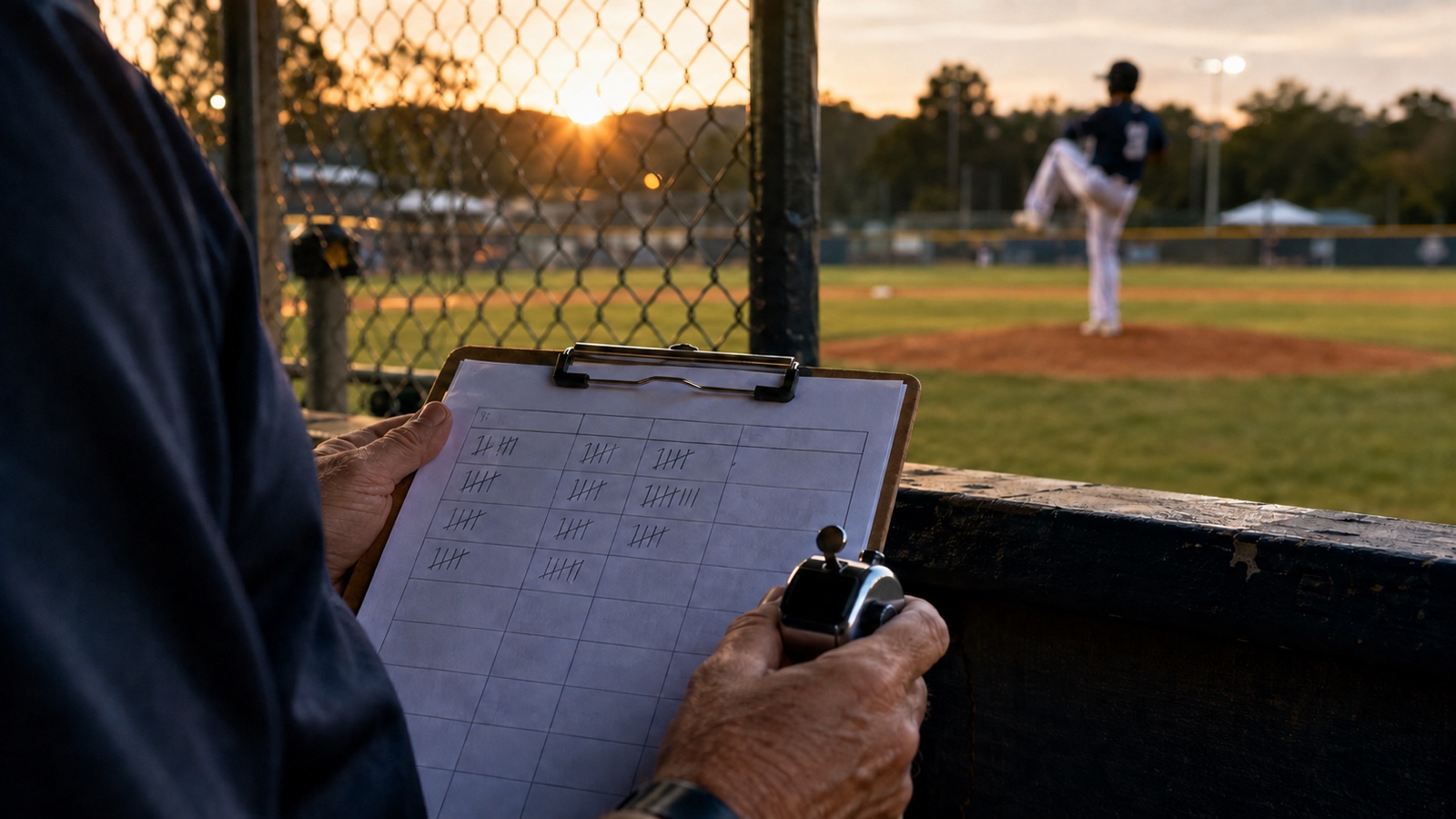
It is Sunday morning. Bracket game. Your starter is at 54 pitches.
The number is right there. Everybody can see it. Somebody has the counter, somebody else is checking the book, and nobody wants to be the coach who misses the daily limit.
But the harder question is not how many he has thrown today.
It is how much rest he had before the first pitch.
That sounds like the quieter half of the pitch-count rule. In one youth-baseball study, it was the part that got missed most often.
The evidence—and the boundary around it
A 2021 study in The Orthopaedic Journal of Sports Medicine reviewed pitching records from 100 Wisconsin youth teams. The sample included 1,046 pitchers, 2,439 games, and age divisions from 8U through 14U during the 2019 tournament season.
Researchers compared those records with MLB and USA Baseball’s Pitch Smart guidelines. They looked for three things: a pitcher going past the recommended daily maximum, pitching without the recommended rest, or pitching more than once on the same day.
Ninety-four percent of the teams had at least one pitcher whose usage fell outside a Pitch Smart recommendation. Nearly half of the pitchers—48.6%—had at least one such occurrence.
The part we cannot get past is the split:
| What fell outside the guideline | Share of pitchers in the study |
|---|---|
| Inadequate rest between appearances | 43.3% |
| Pitched more than once on the same day | 26.7% |
| Exceeded the daily pitch maximum | 9.5% |
Those categories can overlap, so they should not be added together.
There is an important correction to carry with those numbers. In a 2022 letter, the Pitch Smart Advisory Committee said very few—and possibly none—of the sampled teams were playing under rules that formally mandated Pitch Smart. The word “violation” in the study describes a departure from a health-and-safety recommendation. It does not necessarily mean a coach broke the rulebook for that event.
That distinction matters. This is not evidence that 94% of youth coaches knowingly ignored a rule. It is evidence that, in tournament environments where the recommendation was not doing the enforcing, the pitching records often landed outside it.
What the pattern may mean
The daily maximum is the loud number. It lives in the current game. The scorekeeper can see it climb one pitch at a time, and the decision has a clean edge: stop before the cap.
Rest is a timeline. To get it right, somebody has to carry Friday into Saturday and Saturday into Sunday. They have to know the pitcher’s age, the number thrown on each prior date, and which recommendation or event rule governs the next appearance.
The study’s gap between inadequate rest and daily-maximum misses suggests that youth staffs may be better at counting the outing in front of them than carrying workload across the calendar.
That reading fits the way a tournament weekend feels. The scoreboard starts over. The bracket starts over. The pitch count on the new game starts at zero.
The arm does not.
GameLense's own published data gives us a related reason to pay attention to workload. In the first Through the Lense installment, we grouped 4,717 plate appearances from eight 10U–12U travel teams by the pitcher's count within an outing. Hit rate climbed from 24% in the first 20 pitches to 39% at pitches 61–80, while walk rate fell from 17% to 7%.
That observation did not study rest, and it did not establish that fatigue caused the change. What it showed was narrower: workload can move the shape of an outing while the most obvious warning column—the walks—looks better. The Wisconsin study carries that same blind-spot question across dates instead of innings.
Pitch Smart itself treats this as a shared-record problem. Its current guidance says each league, travel team, showcase, or tournament should establish workload rules. It also says the parent and athlete ultimately have to keep the age-group guideline in view across a year that may include multiple leagues and affiliations.
That is not a satisfying handoff, but it is an honest one. No single coach is guaranteed to see the complete workload unless the adults around the player make it visible.
What this does not prove
This study did not test whether a particular pitching occurrence caused an injury. It compared recorded usage with a published guideline.
It also did not represent every youth-baseball environment. The data came from one state, one tournament season, and teams from 8U through 14U. A Wisconsin summer in 2019 is not a national census of travel baseball in 2026.
The records came from GameChanger. They could show pitches entered in those team scorebooks; they could not guarantee a complete account of bullpens, lessons, showcases, another team’s games, or any throwing that happened outside those records.
And Pitch Smart is guidance, not a replacement for the official rules at a specific event or for medical judgment. If a league or tournament is stricter, the stricter rule wins. If a player reports pain or unusual fatigue, a legal pitch count does not make him available.
The narrow claim is enough: in this sample, inadequate rest appeared much more often than exceeding the daily maximum.
The coaching decision it changes
We would change one part of the pregame pitching conversation.
Before asking, “Who gives us the best chance to win this game?” ask, “Who is actually available to pitch this game?”
That first pass should be boring and mechanical:
Only then should matchup, command, efficiency, and bracket strategy enter the room.
This changes the order of operations: availability becomes an input to the pitching plan, not a final check after the preferred starter has already been chosen.
That small change protects the decision from wishful math. Coaches are good at finding reasons their best pitcher can give them one more inning. A dated workload ledger has no idea who the ace is.
The study does not make us think coaches do not care. We do not buy that read.
The more useful read is that the difficult part of the rule is the part spread across time, games, and people. Good staffs can still miss information they never received.
The fix starts with making the information ordinary: one shared record, updated before the lineup card, with the official rule close by.
GameLense’s Pitching Rotation workspace can help carry that record through a tournament. It combines workload recorded or imported into GameLense with age-based rest calculations, flags unavailable pitchers, and checks assignments across tournament days. It still depends on coaches and parents supplying any workload recorded somewhere else.
What to watch next
For the next tournament, track two separate moments.
First, note every time the live pitch count changes a decision. That is the visible safety system working.
Second, note every time prior workload changes a decision before the player ever warms up. That is the quieter system working.
If the second list is empty all weekend, ask whether every pitcher truly arrived fully rested—or whether nobody checked.
That is the next pattern worth watching: not just whether we count every pitch, but whether yesterday’s pitches are still in the room when today’s decision gets made.
---
Evidence note: The primary study covered 100 Wisconsin teams, 1,046 pitchers, and 2,439 games across 8U–14U during the 2019 tournament season. It was a retrospective comparison of recorded pitching usage with Pitch Smart recommendations, not an injury-outcome study. The follow-up advisory letter cautioned that very few to none of the sampled teams were believed to play under formally mandated Pitch Smart limits.See these stats in action
GameLense calculates these stats automatically from your team's GameChanger data.
Start your free trial